A Good Word
A Ministry of Encouragement
editors
Julie Stephens
Sherryl Myrick
Proverbs 12:25
Anxiety weighs down the human heart, but a good word cheers it up.
love left behind
I am writing this lesson just two weeks after the unexpected death of my father, Bob Stephens. I loved my father very much, and I always knew that he loved me as well. All of us have experienced the death of someone we love, like a grandparent, friend, or close relative, but not all have experienced the death of a parent or a child. I now know from experience that this death hits much closer to the heart. We all know that our life here is only temporary, but until you experience the death of a direct blood kin, you realize in a much stronger way that the end of life will come.
I’ve been thinking, and praying, much about what my next lesson might provide as an encouragement in a time of death of a loved one. In all my years of ministry, I’ve written to and visited many friends and family at the passing of one of their loved ones. I often wondered what the right words were to say at such a time; now I know. I am an encourager by nature; therefore, I’ve always wanted to say the right words to help a grieving friend. The book of Job gives us good insight on what to do and what not to do as friends seeking to give comfort. Job had just lost several of his children to death, and his friends came to visit. They started off on the right track, but as moments passed they began to think they needed to give answers as to why the misfortune may have taken place.
No one here really knows the answers; so don’t try to give any. When Job’s friends arrived, the Bible says, “Then they sat on the ground with him for seven days and seven nights. No one said a word to him, because they saw how great his suffering was” (Job 2:13 NIV). Now don’t show up to plan to stay seven days, but do know that saying less is best. There are times when less is best, and this is one of them. Just give a warm hug, or handshake, and say that you are sorry for their loss. The person grieving may ask you for answers, but stay with the plan of “I’m sorry.”
The untimely passing of my father was a shock to me when I first heard it. I understood what my sister was telling me, but my brain didn’t know how to receive what I was hearing. My computer (brain) was starting a new program, and it didn’t know how to process the information. All I knew to do is what I had conditioned myself to do: pray for help. The Bible teaches, “He will have no fear of bad news; his heart is steadfast, trusting in the LORD” (Psalm 112:7). I remember back to my high school football playing days; we practiced weeks and hours in order to be ready for the actual game. If an opponent would suddenly score an unexpected early touchdown, we wouldn’t panic and be caught off-guard. But through the conditioning of consistent practice, we knew what our assignment in the game was; we stuck to the game plan. I say this to encourage you to be consistent with your Bible studies. “Practice” each morning, and no matter what is thrown your way each day, you will automatically know how to respond toward your assignment.
I had the honor to perform the graveside ceremony for my family at my dad’s burial. I sought words of encouragement to share with my hurting family, and to myself as well. I will share a couple of verses that especially helped me: The Bible says, “Precious in the sight of the LORD is the death of his saints” (Psalm 116:15 NIV). The American theologian Albert Barnes (1798-1870) explains this verse: “the idea here is, that the death of saints is an object of value; that God regards it as of importance; that it is connected with his great plans, and that there are great purposes to be accomplished by it. The idea here seems to be that the death of a good man is in itself of so much importance, and so connected with the glory of God and the accomplishment of his purposes, that he will not cause it to take place except in circumstances, at times, and in a manner, which will best secure those ends.” I know that the death of a saint (believer) is precious in the Lord’s sight, for Jesus tells us, “In my Father's house are many mansions: if it were not so, I would have told you. I go to prepare a place for you” (John 14:2 NKJ). As a believer, I look forward to moving into the place Jesus has prepared especially for me.
As far as an untimely death goes, I’m not certain when a good time for death comes for one that we love, but I do take comfort in the verse: “Good people pass away; the godly often die before their time. But no one seems to care or wonder why. No one seems to understand that God is protecting them from the evil to come. For the godly who die will rest in peace” (Isaiah 57:1-2 NLT). When seemingly bad things happen, it’s not for us to try to figure out why; God’s ways are not our ways. It’s certainly OK to be sad, but believe that there is a purpose and plan for each of us. The Bible also teaches that we shall see each other again, and I believe that my father may be fishing with his brother in heaven like they loved to do here on earth. Dad missed his brother. The Bible tells us that King David missed his first son of Bathsheba at his child’s early death, but he says, “I will go to him, but he will not return to me" (2 Samuel 12:23 NIV).
Now I will share something very personal to me that has a message of encouragement. I remind you that I wrote a book entitled Things Don’t Just Happen. I say this to emphasize that I continue to see “happenstances” in my life that are so very timely, and I know they are not mere “coincidences.” During this time of the sadness of losing my father I needed encouragement. You know, the kind that only a father can give to let you know you’re on the right track. At my parent’s house, I was looking through my father’s filing cabinet for financial documents to organize for my mom. I came across a file that said, “Personal.” I felt very awkward in even opening it, because while my dad was alive I certainly wouldn’t open up any of his personal things. As I was thumbing through this personal file of old military documents and a few postcards, I came across a hand written four page letter that was sitting unfolded all by itself. It had never been prepared for mailing. I open it up and the first words on the letter are: “Dear Robby,”
I don’t know what you would do in this situation, but my heart began to pump very fast, and I closed the letter immediately after reading the opening. I was thinking, “I’ve never received a four page letter from my father in all of my life. What would this letter possibly be addressing? Did I somehow unknowingly hurt him in the past that he would write a letter to me and not mail?” As badly as I wanted to read it at that moment, I just couldn’t. I took the file to my mom and asked her to read the letter later, and to let me know if it were something I would want to read. She said she would. The next day came, and I couldn’t get the letter out of my mind. My mother had forgotten about it, so I had to remind her again. She read it in front of me as I tried to get a reading of its content by the expression of her face. I got no signal, but when she finished reading she said, “You will want to read this, but probably not now.” I’m thinking, “What does that mean?” So I ask her, “Is it bad?” She said, “No, it’s very good.”
The day before I had performed my father’s graveside service, I spoke of his tough discipline in my life, but how I always knew he had my best interest in his heart. The Bible says, “the LORD disciplines those he loves, as a father the son he delights in” (Proverbs 3:12 NIV). I always knew that my father “delighted” in me, even though he rarely gave me compliments. He always pushed me to be the best that I could be, and never to settle with being normal. I actually have a handicap that few even know about, and it was due to that reason that my father would never allow me to feel sorry for myself, but to excel in everything I undertook.
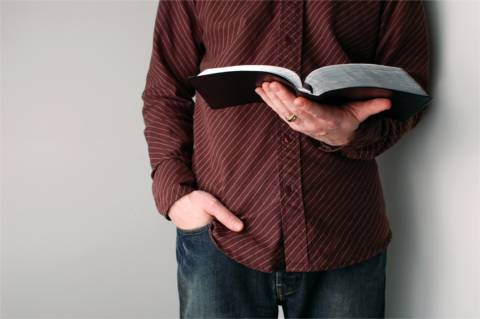
It was in this letter from my father that he first ever addressed this reason of “pushing me” to always achieving my best. He spoke of his great love for me, and how I had made him so very proud; words I hardly ever heard aloud. It was a letter of love left behind. Did you know that you have such a letter, too? It’s written to you as personally as this letter was written to me. It’s called the Bible. In its contents you will read what your heavenly Father wishes to tell you. He writes to tell you instruction, discipline, encouragement, and He will especially write of His love for you. (He gave you a wonderful gift that you can accept.)
You see, you also were born with a handicap. Not a physical one like mine, but a spiritual one. Through the seed of Adam, the first man, we were all born with the nature of sin—all needing a Savior. Very much like my earthly father desired for me to achieve my best through my handicap, God desires for you to achieve your best. He doesn’t give many “at-a-boys” (pats on the back) when you are in His will, but He, too, will quickly give you discipline when you stray away from his will. He tells us this in the book of Jeremiah 29:11-13: “‘For I know the plans I have for you,’ declares the LORD, ‘plans to prosper you and not to harm you, plans to give you hope and a future. ‘” Do you desire to achieve your best for you and your family? You can. Just read His love letter left behind for you, and be sure to follow His advice.
Robby