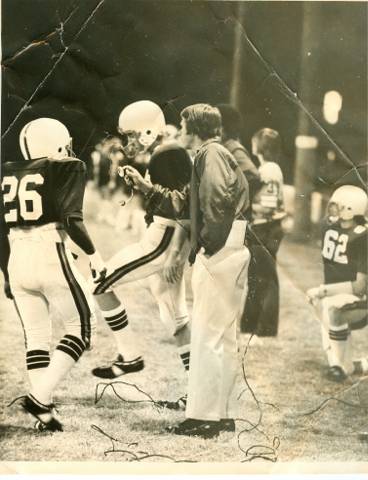
Who's Calling Your Plays?
The old photograph above was taken in the fall of 1974. It is a picture of my high school football coach calling a play to run in the game being played out on the field. That’s me receiving the call with my leg lifted up to step over the headset wire. I’m going in as the quarterback to run the play as called. There is a crowd of witnesses all around us beyond what the photograph shows. What do you think would have happened if I had run in and decided to call my own play in the huddle after receiving the instruction from Coach?
If you are a former member of this same team, you know what would happen next. (It wouldn’t be pretty.) The result of the play, whether great or bad, would not matter. What would matter is the fact that I decided to call my own play. Did you know that our life is very much like a game, as well? Every day there are “plays” (decisions) to call in our game of life. Who’s calling your plays?
You may say, “Robby, I call my own plays. I don’t need any help or assistance in the decisions I make, and so far I’m doing pretty good.” I say, I’m glad to hear that things are going well for now, but let me give you a word of warning: Just like in the football game above, I could call many plays on my own that may even result in a touchdown, but over time my limited vision of the playing field would catch up to my decisions. Yes, I could make it through the game making all my own calls (if Coach would have allowed it), but I can assure you that the results of the game would have been much different than if I allowed Coach to call the plays. You see, Coach had an assistant sitting in a skybox above looking down on the entire playing field. This assistant, with a much larger field of vision, could actually predict which plays would be successful and which plays would result in failure. Wouldn’t it be nice if we had a way to receive that larger “field of vision” assistance in the decisions we make?
There are many stories in the Bible about a “player” in the game of life starting out listening to the direction of the One who can see the playing field (and the future as well), but over time they begin to think that they can make their own calls. Slowly but surely, their own play calling ends up in some sort of trial or tragedy. Perhaps this Book is trying to tell us something about our own lives? The Bible says, “Woe to those who are wise in their own eyes and clever in their own sight” (Isaiah 5:21 NIV). You may ask, “Why does the verse use the word “woe.” Webster defines the word woe as, “used to express grief, regret, or distress.” In other words, the Bible verse could say, “Distress will come to those who are wise in their own eyes and clever in their own sight.” In the early part of the Old Testament there are stories about the many kings who ruled in the beginning of Israel. You can tell very early in the reading if the king were to fall under the “woe” category. His mention would start off like this: “He did evil in the eyes of the Lord” (2 Chronicles 21:6). If the beginning started off with these words, this guy’s life was going to end in a bad way. Oh, he would have many luxuries of this world on his way while calling his own plays, but his end was filled with grief, regret, and distress. I would rather be the king whose mention would start off with this: “did what was right in the eyes of the LORD” (1 Kings 15:11). This normally meant that this king followed the plays as called by the Lord, and that particular king’s life ended pretty well. Yes, he had a few trials to work through, but the Lord guided him through ALL the difficult times.
As I was reading about the kings and their beginnings, this one king in particular caught my attention: King Joash, found in 2 Chronicles. The Bible says, “Joash was seven years old when he became king, and he reigned in Jerusalem forty years” (2 Chronicles 24:1). It seems by his rule of forty years that he must have been pretty good, but what caught my attention is his beginning mention. He started off doing right in the eyes of the Lord, which meant obeying the plays called: “Joash did what was right in the eyes of the LORD …” (v. 2), but with this particular king there were some added words to his beginning: “all the years of Jehoiada the priest” (v.2). King Joash did what was right in the eyes of the Lord in all the years of the life of Jehoiada the priest. You may ask here what I asked myself: What value did Jehoiada the priest add to the life of Joash? Could Jehoiada the priest have been like Coach, helping to call the plays? Is it possible that Joash became wise in his own eyes, and started to call his own plays?
This passage in the Bible is a very interesting read. Joash did start out well, and he did listen to the plays called by the Lord through Jehoiada. The Bible says, “Jehoiada chose two wives for him (Joash), and he had sons and daughters” (2 Chronicles 24:3). Joash went on to do good by restoring the Temple of the Lord. He asked the people to do as Moses had commanded and give their money and skills toward the rebuilding of the Temple. This too shows that Joash was following the plays called by the Lord. Things were going well for Joash, but something changed. The Bible says, “Now Jehoiada was old and full of years, and he died at the age of a hundred and thirty. He was buried with the kings in the City of David, because of the good he had done in Israel for God and his temple” (v. 15, 16). Now the “play caller” of the Lord has passed on. Who calls the plays now? Do you have a “play caller” assigned by the Lord to your life? Are you listening to him/her? If you’re not listening to the Lord’s call on your life, then you’re listening to someone else.
After the death of Jehoiada, Joash had a decision to make in his game of life. Very much like my choice to call the play sent in by Coach, or to listen to others (did you know that offensive linemen always had suggestions of plays to call), Joash had to choose who was calling his play. The Bible says, “After the death of Jehoiada, the officials of Judah came and paid homage to the king, and he listened to them” (2 Chronicles 24:17). Did you catch that last part … he listened to them. So you may think, “What’s the big deal, Robby? Perhaps Joash grew up in the Temple because his parents made him. Didn’t you just say earlier that Joash was seven when he became king? Maybe it’s time for Joash to make some decisions for himself. What’s the harm of doing your own thing?”
I say I understand your thought. I can remember sitting next to my father in church when I was about seven. It was boring! I couldn’t wait until I grew up and didn’t have to sit there so quiet and still. I finally became a teenager, and I sat in the balcony with my buddies. We would play paper football during the service and have a good ‘ole time. I grew up, graduated from college, got married, had a kid, got a good job, and I made my own decisions. I went to church mainly for my wife, Julie, so thanks to her I would hear a play called from Above from time to time. (Praise the Lord for a God loving wife!) But I continued to ignore the play called for the most part, and I continued to call my own plays. What was the possible harm in doing this? I was getting through the game of life pretty well.
Now we come back to Joash listening to his officials now that Jehoiada is no longer around. The very next verse says: “They abandoned the temple of the LORD, the God of their fathers, and worshiped Asherah poles and idols. Because of their guilt, God's anger came upon Judah and Jerusalem. Although the LORD sent prophets to the people to bring them back to him, and though they testified against them, they would not listen” (v. 18- 19). Sounds like a “woe” to me. Is it possible for us to make our own calls, abandon the calls of the Lord, and worship our own idols such as money, stuff, and personal pleasure? I think so, because I’ve been there and done that. But I want you to catch an important Good Word in the verse I just quoted: The Lord sent prophets (preachers and teachers of the Word) to bring them (us) back to Him. I thank God that He is a God of second chances in life. Just perhaps you’re not reading this as something that “just happened.” I hope you are listening, not to me, but from the Chief Play-Caller. Who’s calling your plays?
Joash chooses not to listen, and continues his own play calling. His life continues to spiral downward. The Lord sends “Zechariah son of Jehoiada the priest” (v.20). Perhaps since Joash listened to Jehoiada, he would listen to his son? Not only did he not listen, he had Zechariah killed in the Temple. Now this is significant, because the Lord Jesus brings up a story in the book of Matthew about a Zechariah being stoned to death in the Temple because the people wanted to make their own calls. This had happened over five hundred years before the birth of Jesus, and things have not changed much in the two thousand years after His birth. God sent his own Son, because He is a God of second chances. Joash ended his reign as king with a small Aramean army capturing the much larger army of Joash. Since Joash desired to call his own plays, the Lord let him fight his own battles alone. The Bible says, “When the Arameans withdrew, they left Joash severely wounded. His officials conspired against him for murdering the son of Jehoiada the priest, and they killed him in his bed. So he died and was buried in the City of David, but not in the tombs of the kings” (v. 25). This is a bad ending to what started out as good. I don’t know about you, but I want my chapter of life written as: “Robby did what was right in the eyes of the Lord.”
I’ve asked a couple of times about who’s calling your plays. Do you know? I made the statement earlier that it would be nice to be able to receive assistance about our decisions of life from a source that had a larger field of vision in calling our plays. There is only One who knows our end from our beginning. God says, “I make known the end from the beginning, from ancient times, what is still to come. I say: My purpose will stand, and I will do all that I please” (Isaiah 46:10). The Lord knows what is still to come in your life. Do like I finally did and turn your life over to His calling the plays for you. Ask Him into your life and to guide you on all the calls you make. You have your instructions now. The play is called. I’m sending you back into the game.
Robby